

Treatment of Lipedema
An individualised treatment plan is the foundation of successful care.
Lipedema is a chronic disease of adipose tissue for which there is currently no cure. Although the condition cannot yet be eliminated completely, carefully selected measures can significantly reduce symptoms, slow its progression and improve quality of life in the long term.
Current European guidelines recommend a holistic approach that includes both conservative and surgical methods. The foundations of care are regular physical activity, appropriate dietary habits, compression therapy, lymphatic therapy, skin care and psychological support. For selected patients, surgical removal of pathologically altered adipose tissue by liposuction is also an important part of treatment.
The choice of measures depends on symptoms, stage of the condition, its impact on quality of life and the goals of the individual patient. At our centre, we prepare an individual treatment plan and advise patients on the most effective conservative measures and other forms of care that can help them manage the condition over the long term.
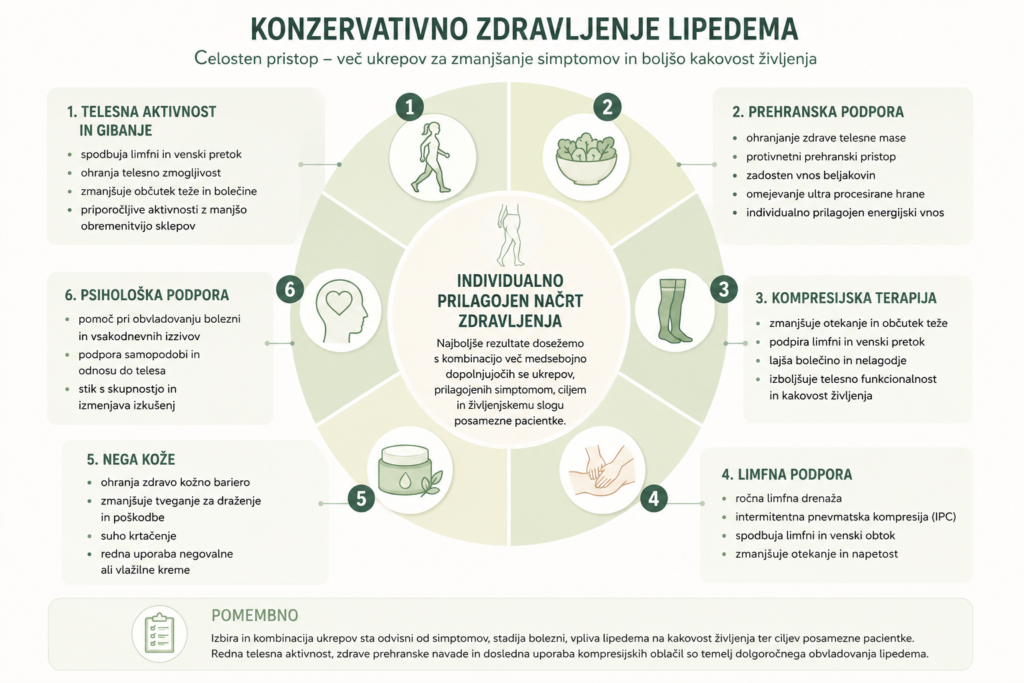
Conservative treatment of lipedema
Conservative treatment is the cornerstone of care for all patients with lipedema, whether or not surgical treatment is also planned. The aim of conservative measures is to reduce pain, heaviness, swelling and other symptoms, while preserving mobility, physical capacity and quality of life.
Although conservative measures do not remove pathologically altered adipose tissue, they can make an important contribution to long-term management. Current European guidelines recommend a multimodal approach that combines several complementary measures.
1. Physical activity and movement
One of the most important measures you can take yourself.
Physical activity plays an important role in the long-term management of lipedema. Although exercise cannot usually eliminate pathologically altered adipose tissue completely, regular movement can make a significant contribution to maintaining a healthy body weight, physical capacity and general health.
Movement activates the muscle pump, improves lymphatic and venous flow, promotes the return of interstitial fluid from the lower limbs and helps maintain joint mobility.
For many patients, regular physical activity reduces feelings of heaviness and tightness in the legs, improves fitness and makes daily activities easier. It also makes an important contribution to maintaining long-term independence and quality of life.
Activities that place less strain on the major joints are particularly recommended:
› Nordic walking
› cycling
› swimming
› supervised exercise in water
› strength training
› mobility and stabilisation exercises
A physical-activity programme should always be tailored to the individual and her symptoms. When planning exercise, collaboration with a kinesiologist or another appropriately trained professional is recommended to help design a safe and sustainable long-term programme.
2. Nutritional support
Nutrition does not cure lipedema, but it can have a significant effect on symptoms.
Lipedema is not caused by an unhealthy diet and cannot be cured through dieting. Nevertheless, nutrition plays an important role in maintaining a healthy body weight, reducing systemic inflammation and supporting metabolic health. Many patients find that a balanced dietary pattern helps reduce fluid retention, improves energy levels and makes long-term disease management easier.
Current recommendations particularly emphasise:
› adequate protein intake
› a diet high in unprocessed foods
› limiting ultra-processed foods
› reducing simple-carbohydrate intake
› individually tailored energy intake
When necessary, we can also recommend specialist nutritional advice.
3. Compression therapy
The cornerstone of symptomatic treatment.
Medical compression garments are one of the most important therapeutic measures in the treatment of lipedema. Compression reduces fluid retention in the tissues, supports lymphatic and venous flow, and helps reduce pain, heaviness and swelling.
Many patients find that compression garments make daily activities and movement easier. By reducing heaviness, tightness and discomfort in the legs, they can make it easier to take part in physical activity, which is an important part of long-term management.
Compression therapy does not directly affect the amount of pathologically altered adipose tissue, but it can significantly improve symptoms, physical function and quality of life. The type of garment, compression class and wearing regimen must be individually tailored to each patient’s symptoms, anatomy and needs.
4. Manual lymphatic drainage
Particularly helpful for patients with more pronounced swelling.
Manual lymphatic drainage is a specialised therapeutic technique designed to stimulate lymphatic flow and reduce fluid retention in the tissues. It is performed by a suitably trained lymphatic therapist. Unlike classical massage, it uses precise, gentle movements that stimulate the lymphatic system and may reduce swelling and the sensation of tightness.
It is usually most beneficial for patients with more pronounced swelling or associated lymphatic-system involvement, particularly when combined with compression therapy.
5. Intermittent pneumatic compression
Additional support for lymphatic and venous circulation.
Intermittent pneumatic compression uses special compression sleeves connected to a device that creates rhythmic pressure waves along the limbs.
This therapy promotes fluid movement through the tissues, supports lymphatic and venous flow, and can help reduce pain, swelling and the sensation of heaviness in the legs.
An important advantage is that patients can use it independently at home, allowing regular, long-term treatment between visits to a lymphatic therapist. Although intermittent pneumatic compression cannot fully replace professionally performed manual lymphatic drainage, it can be a useful adjunct for many patients and can help with day-to-day symptom management.
For some patients, it is particularly helpful during periods of more pronounced swelling or when regular manual lymphatic drainage is unavailable or impractical. It is generally used as an adjunct to compression therapy and other conservative measures.
6. Skin care
An important but often overlooked part of treatment.
Skin in affected areas may be more sensitive to mechanical stress, irritation and injury. In patients with advanced lipedema or associated lymphedema, the risk of skin and subcutaneous-tissue infections is also increased.
Regular skin care helps maintain the protective function of the skin barrier, reduces the risk of complications and is an important part of long-term self-care. Regular use of moisturising and nourishing creams is recommended to help keep the skin healthy and supple.
Some patients also benefit from dry brushing, which involves gently brushing the skin with a soft brush in strokes towards the torso. Although scientific evidence for its effects remains limited, it may help some individuals develop better body awareness, stimulate superficial lymphatic flow and improve the sensation of lightness in the limbs. Dry brushing should be done gently and is not recommended on areas of inflamed, damaged or markedly sensitive skin.
7. Psychological support
An important part of holistic care.
Lipedema affects not only the body but often psychological well-being. Before diagnosis, many women live for years with pain, swelling and changes in their body for which they cannot find an explanation. They are often advised simply to exercise more or lose weight, even though they do not see the expected results despite considerable effort.
Such experiences can lead to frustration, helplessness, guilt and feeling misunderstood. Chronic pain, limitations in daily activities and changes in body image add to the emotional burden of the condition.
Research shows that symptoms of anxiety, depression and body-image distress are more common in women with lipedema than in the general population. It is important to emphasise that these feelings are not a sign of personal weakness, but an understandable response to living with a chronic and often poorly recognised condition.
Psychological support can help with accepting the condition, coping with chronic symptoms and improving quality of life. Modern lipedema care therefore includes attention to the patient’s psychological well-being, rather than reducing physical symptoms alone. The Slovenian Professional Association for Lymphedema (SSZL) is also an important source of information, support and connection with others living with lipedema in Slovenia; its website offers information about lipedema, a list of lymphatic therapists and opportunities to join a community of people with similar experiences.
Successful treatment of lipedema does not consist of a single method. The best results are usually achieved through a combination of several complementary measures tailored to the individual patient, her symptoms and her lifestyle.
Read more:
How do individual measures help with lipedema?
Lipedema is a multifaceted chronic condition involving changes in adipose tissue, microcirculation, the lymphatic system and neural pain pathways. Because individual symptoms arise from different pathophysiological mechanisms, effective long-term management usually requires a holistic approach.
Current guidelines therefore recommend a combination of conservative measures that act on different aspects of the condition. The goal is not simply to reduce limb volume, but above all to reduce pain, improve physical function and preserve quality of life.
Below, we explain how each measure works and what benefits can realistically be expected.
Why are modern recommendations for exercise different from the past?
For many years, lipedema treatment focused mainly on reducing body weight. Today we know that this view is too simplistic. Research shows that physical capacity is one of the most important factors affecting quality of life in women with lipedema. The goal of exercise is therefore not only weight loss, but above all maintaining muscle strength, mobility, endurance and the ability to perform daily activities. For many patients, reduced physical activity creates a vicious cycle: pain and a sensation of heaviness lead them to move less; as a result, physical fitness and muscle strength decline, which can further worsen their problems.
Strength training—an often overlooked part of treatment
In the past, experts focused most on walking, swimming and other aerobic forms of activity. In recent years, however, research has increasingly highlighted the importance of strength training. Stronger leg and trunk muscles improve joint stability, increase physical capacity and support the muscle pump that helps return blood and interstitial fluid from the lower limbs. Strength training can also help reduce the functional limitations that often arise in advanced stages of the condition. The aim is not to lift heavy weights or undertake intensive athletic training. Gradual progression and regularity are far more important. For most patients, exercises using body weight, resistance bands or moderate loads tailored to individual ability are appropriate.
Why is exercise in water particularly helpful?
Water-based exercise offers several benefits in lipedema. Buoyancy places less strain on the joints, so movement is often easier and less painful than on land. At the same time, water creates even pressure on the limbs, acting similarly to mild compression. Many patients therefore feel less heaviness in their legs and greater ease of movement while swimming or walking in water.
What should I do if exercise causes pain?
Many patients report that certain forms of exercise temporarily increase pain or a sensation of heaviness. This does not necessarily mean that physical activity is harmful. The issue is often increasing the load too quickly, choosing an unsuitable activity or not allowing enough time for the body to adapt to a new level of activity. In these cases, it is usually sensible to reduce intensity, shorten the duration of exercise or choose another form of movement that the body tolerates better. For many patients, exercising in compression garments can additionally reduce heaviness and discomfort during activity.
An individual approach is essential
There is no universal exercise programme for lipedema. The most appropriate type of movement depends on disease stage, fitness, associated health problems, level of pain and the individual’s personal goals. Collaboration with a kinesiologist or another appropriately trained movement professional who understands the specific features of lipedema is therefore recommended. The aim is not short-term intensive activity, but a way of moving that can be incorporated into daily life and sustained long term.
Why does nutrition affect lipedema symptoms?
Lipedema is not caused by poor nutrition, but dietary habits influence many factors that can affect symptom severity. These include body weight, metabolic health, fluid retention, the level of systemic inflammation and general physical capacity. Research shows that associated obesity can place additional strain on the lymphatic and venous systems, increase mechanical stress on joints and worsen many lipedema symptoms. This is why current recommendations do not focus only on weight loss, but above all on the long-term maintenance of metabolic health and a healthy body composition. It is important to stress that adipose tissue in lipedema generally responds differently to dietary measures than ordinary adipose tissue. Even with successful weight loss, its volume may decrease only partly, so the disproportion between the limbs and torso often remains. Nevertheless, a well-chosen dietary pattern can significantly reduce everyday problems for many patients.
Which dietary approaches have the strongest research support?
There is currently no single dietary pattern recommended for everyone with lipedema. Most clinical recommendations are based on principles of anti-inflammatory eating and improved metabolic health. The best-supported dietary patterns include:
› a high proportion of vegetables and other unprocessed foods
› adequate intake of high-quality protein
› limiting simple carbohydrates
› limiting ultra-processed foods
› adequate intake of healthy fats
› individually tailored energy intake
A dietary approach often mentioned in recent years for people with lipedema is the RAD (Rare Adipose Disorder) approach, developed for people with rare adipose-tissue disorders, a group that includes lipedema. It is based on an anti-inflammatory way of eating with a high proportion of unprocessed foods, adequate protein intake, restriction of sugars and ultra-processed foods, and individual adjustment of carbohydrate intake.
Lower-carbohydrate eating patterns and ketogenic approaches have also attracted researchers’ attention. Some studies suggest possible reductions in pain, improvements in metabolic markers and reductions in body weight in selected patients. Current evidence does not, however, support concluding that any of these approaches is suitable for everyone with lipedema. Dietary choice must always take the individual’s needs, lifestyle and health status into account.
The role of healthy fats and omega-3 fatty acids
Adequate intake of unsaturated fats, particularly omega-3 fatty acids, also has a special place in an anti-inflammatory dietary approach.
Omega-3 fatty acids are involved in regulating many inflammatory processes in the body and have beneficial effects on cardiovascular and metabolic health. Their most important dietary sources are oily fish, walnuts, flaxseed and chia seeds.
Although there is currently no evidence that omega-3 fatty acids directly affect the amount of lipedema adipose tissue, they play an important role in maintaining an anti-inflammatory dietary pattern and have a favourable effect on cardiovascular and metabolic health. Because many people do not obtain recommended amounts of omega-3 fatty acids from food, supplements may be worth considering for some individuals. Before starting supplements, consultation with a physician or dietitian is recommended to assess actual needs and help select an appropriate product and dose.
What about fasting and other popular diets?
In recent years, various time-restricted eating and intermittent-fasting regimens have become popular. Although some studies in the general population suggest possible metabolic-health benefits, there is currently insufficient high-quality evidence to recommend intermittent fasting as a specific treatment for lipedema.
The same applies to many other restrictive diets that often promise rapid reduction in leg size or elimination of the condition. Such claims are not supported by scientific evidence.
In a chronic condition such as lipedema, the sustainability of a dietary pattern is far more important in the long term than short-lived intensive measures. The aim of nutritional support is not to find the “ideal diet”, but to create a way of eating that can be maintained over time.
Why is protein so important?
For many patients, the aim of nutritional support is to reduce body weight while maintaining or even improving muscle mass. This is why current recommendations emphasise adequate daily protein intake.
Muscle mass plays a key role in physical capacity, muscle-pump function, joint stability and long-term metabolic health. Inadequate protein intake during weight loss can lead to loss of muscle mass, which reduces physical function over time and makes disease management more difficult.
Protein is particularly important for patients who undertake strength training regularly or increase their physical-activity level, as adequate intake supports recovery and maintenance of muscle mass.
What about dietary supplements?
Because of the volume of information online, many patients turn to dietary supplements that promise reduced swelling, improved lymphatic flow or even a reduction in lipedema adipose tissue.
For most supplements marketed specifically for treating lipedema, there is currently insufficient high-quality scientific evidence to confirm their effectiveness. This also applies to many products promoted as “natural lymph stimulants”, “detox preparations” or agents for reducing adipose tissue. Some dietary supplements can interact with medication, increase the risk of adverse effects or contain quantities of active ingredients that are not adequately controlled.
It is therefore recommended that patients consult a physician, dietitian or another appropriately trained healthcare professional before using supplements, rather than introducing them independently on the basis of online recommendations.
An individual approach is essential
There is no single nutritional approach that is suitable for every patient with lipedema. The most successful dietary pattern is generally one that can be sustained long term while supporting healthy body composition, physical capacity and overall health.
For significant dietary changes, collaboration with a dietitian or another appropriately trained nutrition professional is recommended to help develop an individualised approach. The aim is not a short-term diet, but a way of eating that can be integrated into daily life safely, effectively and sustainably.
Why does compression do more than reduce swelling?
Most people associate compression garments mainly with reducing swelling. In lipedema, however, their effects go much further. Compression garments provide mechanical support to the subcutaneous tissue and reduce its movement during walking, running and other physical activity. Because adipose tissue in lipedema is often painful and sensitive to pressure, reducing mechanical stress alone can have a significant effect on everyday well-being.
Compression also supports the return of fluid from the tissues, reduces tightness in the legs and helps limit additional fluid retention, which intensifies during the day for many patients.
Why does compression often make movement easier?
Many patients describe their legs as quickly becoming heavy, tight or painful during walking when they are not wearing compression. This can lead to less movement, reduced physical capacity over time and worsening symptoms. Appropriately selected compression garments can reduce heaviness and discomfort during activity and make more regular movement possible. Many patients report that they can walk more easily, stand for longer or exercise more comfortably when wearing compression.
This is why current guidelines often regard compression therapy as important support for other forms of treatment, especially physical activity.
How soon can I expect an effect?
Some patients feel relief in the first few days of use, while others need several weeks to adapt. It is important to know that compression works primarily when worn regularly. Occasional use generally does not produce the same results as daily wear in accordance with a healthcare professional’s advice.
Why does compression not cure the condition?
Compression therapy does not remove pathologically altered adipose tissue and does not directly affect the underlying cause of the condition. Its main role is to reduce symptoms, improve function and support lymphatic and venous circulation. For many patients, it is one of the most effective ways of managing pain, heaviness and swelling long term.
Does lymphatic drainage help every patient?
Manual lymphatic drainage is one of the best-known measures in the treatment of lymphatic disorders, but its role in lipedema is not the same for every patient. The greatest benefits are usually seen in women with more pronounced swelling, associated lymphedema or advanced forms of the condition in which the lymphatic system has become additionally involved. In patients without significant oedema, the effects are often less pronounced.
The decision to include lymphatic drainage is therefore always made individually, according to the patient’s symptoms and clinical presentation.
Why is the effect often not permanent?
Manual lymphatic drainage helps move fluid out of the tissues and can temporarily reduce tightness, heaviness or swelling. Because it does not directly affect the underlying changes in adipose tissue, fluid can gradually accumulate again. Lymphatic drainage therefore usually achieves the best results in combination with compression therapy, regular movement and other conservative measures. It is also important to emphasise that manual lymphatic drainage is not a conventional massage: it is a specialised therapeutic technique that must be performed by a suitably trained lymphatic therapist.
How does intermittent pneumatic compression work?
Intermittent pneumatic compression uses special sleeves with several separate chambers that inflate and deflate rhythmically. This creates sequential pressure along the limb, encouraging fluid movement through the tissues and supporting lymphatic and venous circulation.
For many patients, it can reduce heaviness, tightness and swelling in the legs and contribute to greater comfort during daily activities.
When is IPC particularly useful?
The greatest benefit is usually seen in patients with more pronounced heaviness, swelling or tightness in the legs. An important advantage of this method is the possibility of regular home use. This enables treatment between appointments with a lymphatic therapist and provides practical long-term support for symptom management.
For many women, intermittent pneumatic compression reduces daily discomfort and complements the effects of other conservative measures.
Can it replace manual lymphatic drainage?
Intermittent pneumatic compression cannot fully replace professionally performed manual lymphatic drainage, but it can be a useful adjunct or alternative for many patients during periods when lymphatic drainage is unavailable. It usually achieves the best results as part of a broader treatment programme that also includes compression therapy, regular physical activity and other conservative measures.
How should dry brushing be performed correctly?
Dry brushing is a simple measure that many patients incorporate into their daily routine. Although scientific evidence for its effects is limited, some women report a greater feeling of lightness in their legs and improved well-being with regular use.
Use a soft brush with natural or synthetic bristles. Brush gently and always towards the torso or areas with major groups of lymph nodes. On the legs, usually start at the feet and use slow strokes upwards towards the knees and groin. On the arms, strokes should move from the hands towards the armpits. Do not rub the skin aggressively. The aim is not to irritate the skin, but to provide gentle mechanical stimulation of superficial tissues.
Dry brushing is not recommended on damaged, irritated, inflamed or infected skin, or on areas with open wounds. After brushing, apply a moisturising or nourishing cream to help maintain the skin’s protective function.
How can lipedema affect everyday life?
Lipedema affects not only physical symptoms but can gradually affect many other aspects of life. Pain, heaviness in the legs, reduced physical capacity and difficulty choosing clothing can influence daily activities, leisure pursuits, social life and self-confidence.
Because of discomfort or embarrassment, some patients gradually give up sports, swimming pools, the beach or other settings where their bodies are more exposed to others’ gaze. Many also describe feeling that their problems are not outwardly visible and therefore often remain misunderstood. Despite pain, swelling and other symptoms, they frequently encounter oversimplified explanations that these are merely a consequence of body weight or insufficient exercise.
Why is diagnosis an important turning point for many patients?
For many women, an accurate diagnosis is the first moment when their problems receive a clinical explanation. Understanding that pain, swelling and disproportionate adipose-tissue distribution are not the result of lack of willpower or poor lifestyle choices often brings considerable relief.
A diagnosis does not itself eliminate symptoms, but it can help reduce the guilt, uncertainty and self-doubt many women experience before diagnosis.
Why is support from other patients often so important?
Living with a chronic condition is often easier when a person knows they are not alone in their experience. Speaking with others who have lipedema provides an opportunity to exchange practical advice, treatment experiences and feelings that people around them may sometimes struggle to understand.
The lipedema section of the Slovenian Professional Association for Lymphedema (SSZL) is also an important source of information, support and connection in Slovenia.
When is it appropriate to seek professional help?
Psychological support is not intended only for people with severe mental-health problems. It can also be useful when the condition starts to have a greater impact on quality of life, self-image, relationships or everyday functioning.
Speaking with a psychologist or another appropriately trained professional can help with coping with a chronic condition, managing stress and developing a healthier relationship with one’s body.
Understanding the condition, support from loved ones, professional help and contact with a community of people with similar experiences are often just as important as individual medical measures. In holistic care, we treat not only physical symptoms, but also their impact on everyday life.