

Stages and Types of Lipedema
Stages and types of lipedema are two different ways of classifying the condition. A stage describes structural changes in the skin, adipose tissue and connective tissue that develop as the condition progresses, whereas the type defines the body regions affected.
Stages of lipedema
It is important to emphasise that the stage of the condition does not necessarily reflect symptom severity. Research and current clinical guidelines show that pain, tenderness to touch, swelling and the impact on quality of life often do not correlate with the extent of visible changes. Some patients in early stages report substantial problems, while others with advanced structural changes may have significantly fewer symptoms.
Stages are therefore primarily a tool for describing anatomical tissue changes and planning treatment, rather than a measure of the severity of an individual patient’s problems.
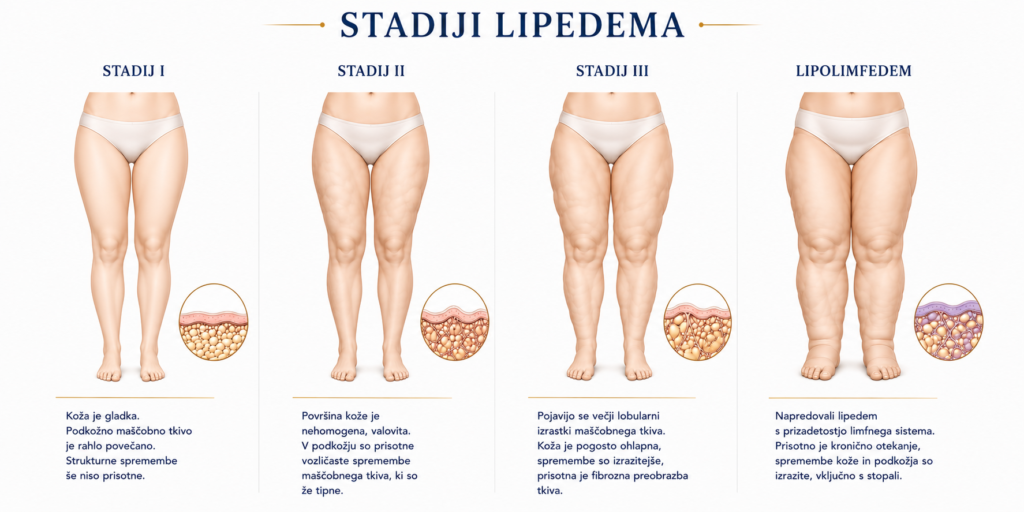
Stage I
In the first stage, the skin surface is still smooth and largely unchanged in appearance. Subcutaneous adipose tissue is already enlarged and structurally altered, but the changes are often not obvious at first glance. A careful examination can detect early changes in the structure of the subcutaneous tissue. Because visible changes are still minimal, lipedema at this stage is often overlooked or mistakenly attributed to ordinary weight gain.
Stage II
In the second stage, the skin surface becomes uneven, wavy or lumpy. More pronounced nodular changes develop in the subcutaneous tissue and can be felt on examination. Changes in the shape of the limbs become more noticeable, and the structure of the subcutaneous tissue gradually loses its usual softness because of progressive fibrosis.
Stage III
The third stage is characterised by pronounced structural changes in adipose and connective tissue. Larger lobules of adipose tissue may develop, particularly on the inner thighs, around the knees and on the lower legs. The tissue becomes firmer and more fibrotic, and the increased tissue mass can affect mobility, posture and daily activities.
Lipolymphedema
In some patients, progression of lipedema may also lead to secondary involvement of the lymphatic system. Increased adipose tissue and progressive fibrosis can gradually impede normal lymphatic flow, leading to the development of lymphedema. When lipedema and lymphedema are present at the same time, the condition is called lipolymphedema. It is characterised by more pronounced swelling, additional changes in the subcutaneous tissue and greater functional impairment. In recent years, some researchers have proposed intermediate stages (for example, 1.5 and 2.5), as transition between stages is often gradual in practice. These proposals have not yet been incorporated into official classification systems, but they reflect the current understanding of lipedema as a continuous process rather than a set of clearly separated stages.
Types of lipedema
Whereas stages describe structural changes in adipose and connective tissue, types define which anatomical regions are affected by lipedema. Knowing the type allows a more precise definition of the affected areas and makes an important contribution to treatment planning. Most patients have a combination of several types, and the extent of affected areas can change over time.
Type I
Changes are mainly limited to the hips, buttocks and upper thighs. The characteristic distribution of adipose tissue is known as the “saddlebag” pattern, in which the increased adipose tissue is most pronounced on the outer and back aspects of the upper thighs and around the hips.
Type II
The affected area extends from the hips to the knees. In addition to the thighs, the inner sides of the knees are often markedly affected, with an increased amount of subcutaneous adipose tissue accumulating there. This can create a characteristic rounded shape of the knees and further accentuate the disproportion between the lower limbs and the torso.
Type III
The most common type of lipedema. Changes extend from the hips to the ankles, while the feet remain unaffected. The sharp boundary between the affected lower-leg area and normally shaped feet (the so-called cuff sign) is one of the most important clinical features of this form of the condition.
Type IV
In addition to the legs, the upper limbs are affected. Adipose tissue may accumulate from the shoulders to the elbows or wrists, while the hands remain unaffected. Arm involvement is present in around 30–50% of patients and often contributes significantly to pain, a sensation of heaviness and functional limitations of the upper limbs.
Type V
Changes are mainly confined to the lower legs, while the thighs and hips remain relatively unaffected. This form is less common than other types of lipedema and can sometimes be harder to recognise, as at first glance it may resemble other causes of lower-leg swelling or enlargement.
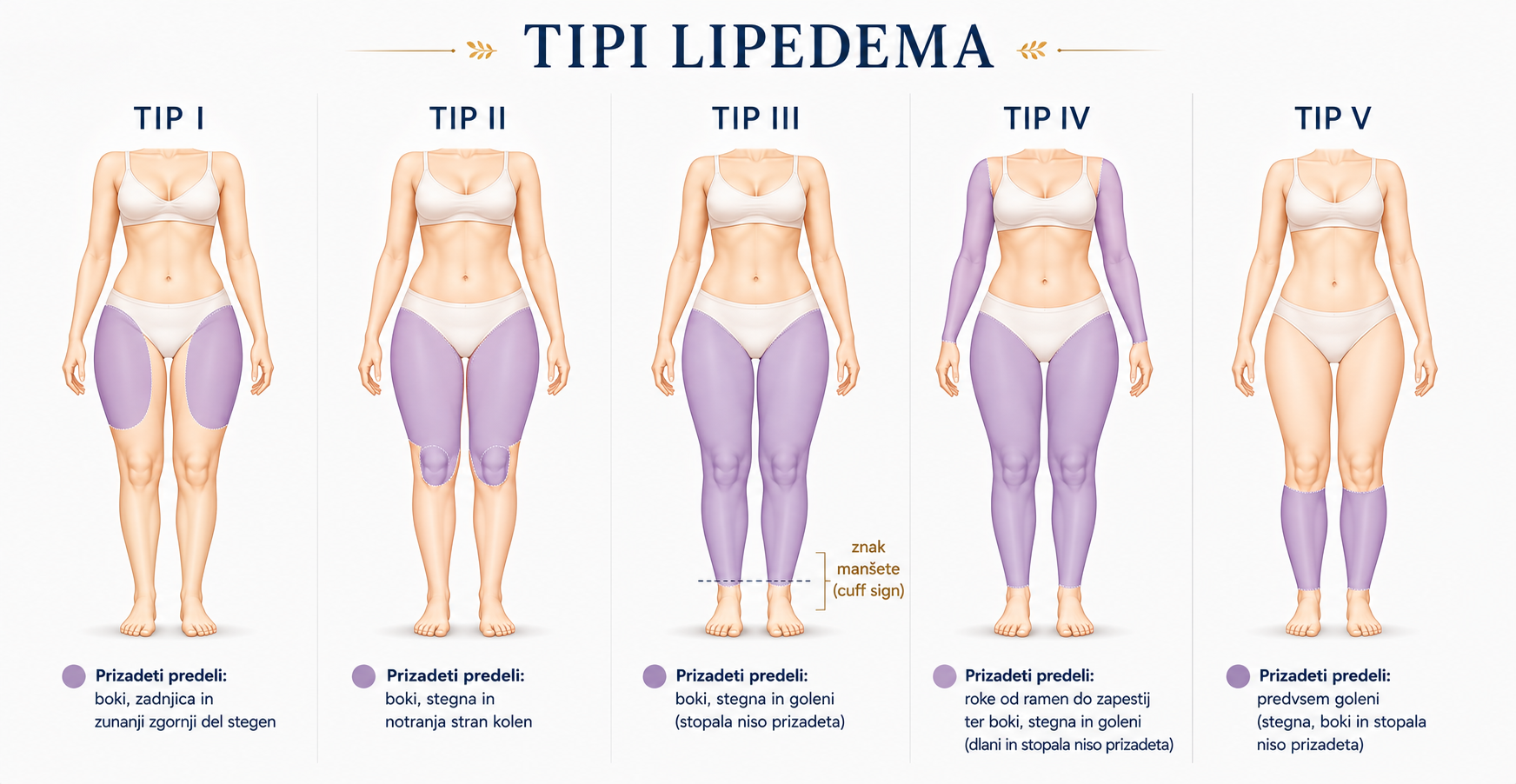
Important: types describe only the anatomical distribution of the condition—the affected areas of the body—not its severity. As with stages, the type of lipedema does not predict the severity of pain, swelling or the impact of the condition on quality of life. Two patients with the same type and stage of lipedema may have entirely different symptoms and treatment needs. A treatment plan must therefore always be based on a holistic assessment of each patient’s problems, rather than on disease classification alone.