
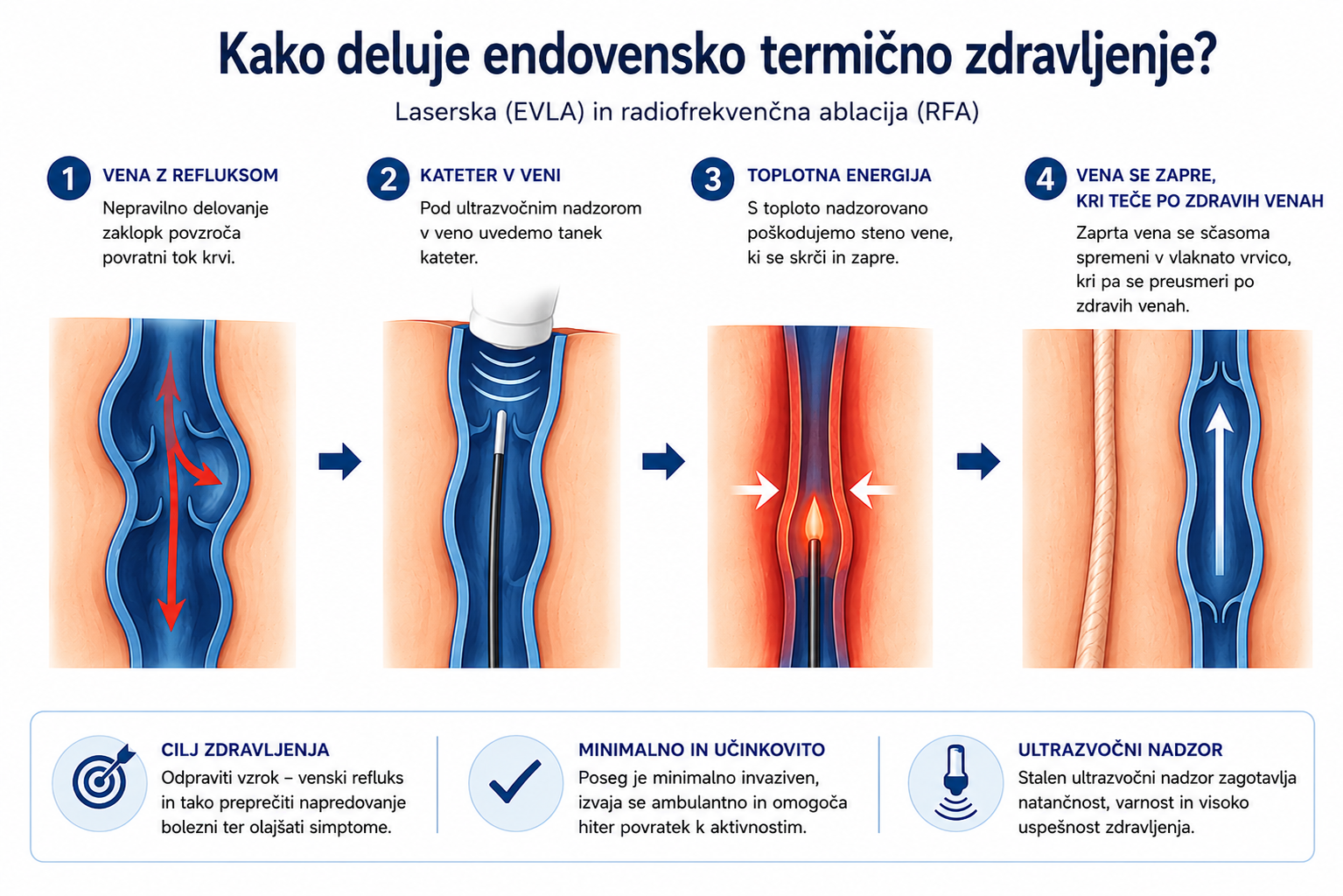
Endovenous thermal treatment is now the standard of modern care for chronic venous disease. It includes laser ablation (EVLA) and radiofrequency ablation (RFA), which work on the same principle: controlled heating permanently closes the affected vein and blood is then redirected through healthy veins.
The procedure is performed under continuous ultrasound guidance through a tiny skin puncture, using local tumescent anaesthesia. The choice between laser and radiofrequency ablation depends mainly on the anatomy of the affected vein and the surgeon’s experience, as both methods achieve comparable long-term results.
In selected patients, the affected vein can also be closed using a special medical adhesive (cyanoacrylate). This method permanently closes the vein without thermal energy and does not require local anaesthetic to be injected around the vein. Because it has specific indications, we use it mainly in carefully selected patients.
Conventional surgery to remove the great or small saphenous vein (stripping) was the standard treatment for chronic venous disease for many decades. Today, it has been replaced in the great majority of cases by modern minimally invasive endovenous methods, which provide equal or greater effectiveness with less surgical trauma, less postoperative pain and faster recovery.
Stripping is now used only exceptionally, when endovenous treatment is unsuitable because of anatomical features or other reasons.
Mini- and microphlebectomies are surgical methods for removing varicose veins through very small skin punctures under local anaesthetic. They allow dilated, tortuous veins beneath the skin to be removed without larger incisions, so sutures are generally not required.
At our centre, we distinguish miniphlebectomies from microphlebectomies by the size of the skin punctures made during the procedure. In miniphlebectomy, veins are removed through punctures 1.5–2 mm in size; in microphlebectomy, even smaller 1 mm punctures are used. Because the skin wounds are exceptionally small, scars are generally barely noticeable after healing and, for most patients, virtually invisible after a few months.
Mini- and microphlebectomies are most often combined with endovenous thermal treatment, so that the source of venous reflux is corrected while visible varicose veins are removed at the same time. This combined approach delivers the best functional and aesthetic result.
In ultrasound-guided sclerotherapy, a special sclerosant, in foam or liquid form, is injected into the affected vein under continuous ultrasound guidance, causing it to close permanently. Blood is then redirected through healthy veins and the abnormal flow is corrected.
The method is particularly suitable for treating individual, deeper varicose veins, recurrence after previous treatment, and veins whose anatomy makes them unsuitable for endovenous thermal treatment.
Ultrasound guidance allows the surgeon to monitor the procedure precisely and inject the sclerosant directly into the affected vein, making an important contribution to treatment safety and success.
Sclerotherapy is the gold-standard treatment for spider veins. During the procedure, a sclerosant in liquid or foam form is injected through a very fine needle into individual vessels, causing them to close gradually. Over time, the treated veins break down and become progressively less visible.
Several sequential sessions are usually required for the best aesthetic result, depending on the extent of the veins, because it is generally not possible to eliminate all spider veins in one procedure. Sclerotherapy is performed on an outpatient basis, takes only a few minutes and requires no special recovery.
Before treatment, it is important to exclude possible venous reflux by ultrasound. If reflux is present and is not treated first, new spider veins may develop more quickly after sclerotherapy.
Modern venous surgery is founded on precise ultrasound diagnostics. Ultrasound is used not only to establish the diagnosis, but is also an indispensable part of planning and performing the procedure.
The surgeon uses ultrasound to define the course of the affected veins precisely, identify the site of venous reflux and monitor the position of the catheter or needle throughout the procedure. This approach enables more precise, safer and more effective treatment.
The choice of surgical treatment is based on ultrasound diagnostics and the anatomy of the affected venous system. The aim is to select the method, or combination of methods, that will correct venous reflux effectively and provide the best long-term result.
For most patients, treatment is based on endovenous thermal closure of the saphenous vein, supplemented where necessary with miniphlebectomy, microphlebectomy or ultrasound-guided sclerotherapy.
Patients stand and walk immediately after the procedure. During the first few days, we recommend regular short walks while avoiding strenuous physical activity and sport.
Compression stockings are usually recommended for about one week, or as directed by the doctor. The length of sick leave depends on the extent of the procedure and the nature of the work; for most patients it is one to two weeks.