
Why Does Chronic Venous Disease Develop?
Several interrelated factors influence the development of chronic venous disease, with inherited predisposition playing the most important role.
For most patients, chronic venous disease does not arise from a single cause, but from the gradual failure of venous valves over many years. The most important risk factor is inherited predisposition: the disease is markedly more common in people whose close relatives have varicose veins or other forms of chronic venous disease. Hormonal factors, female sex, pregnancy, ageing, excess body weight, and prolonged standing or sitting at work also influence its development.
Some risk factors cannot be changed, while others can be partly reduced through an appropriate lifestyle. Understanding them enables earlier recognition of the disease and timely action.
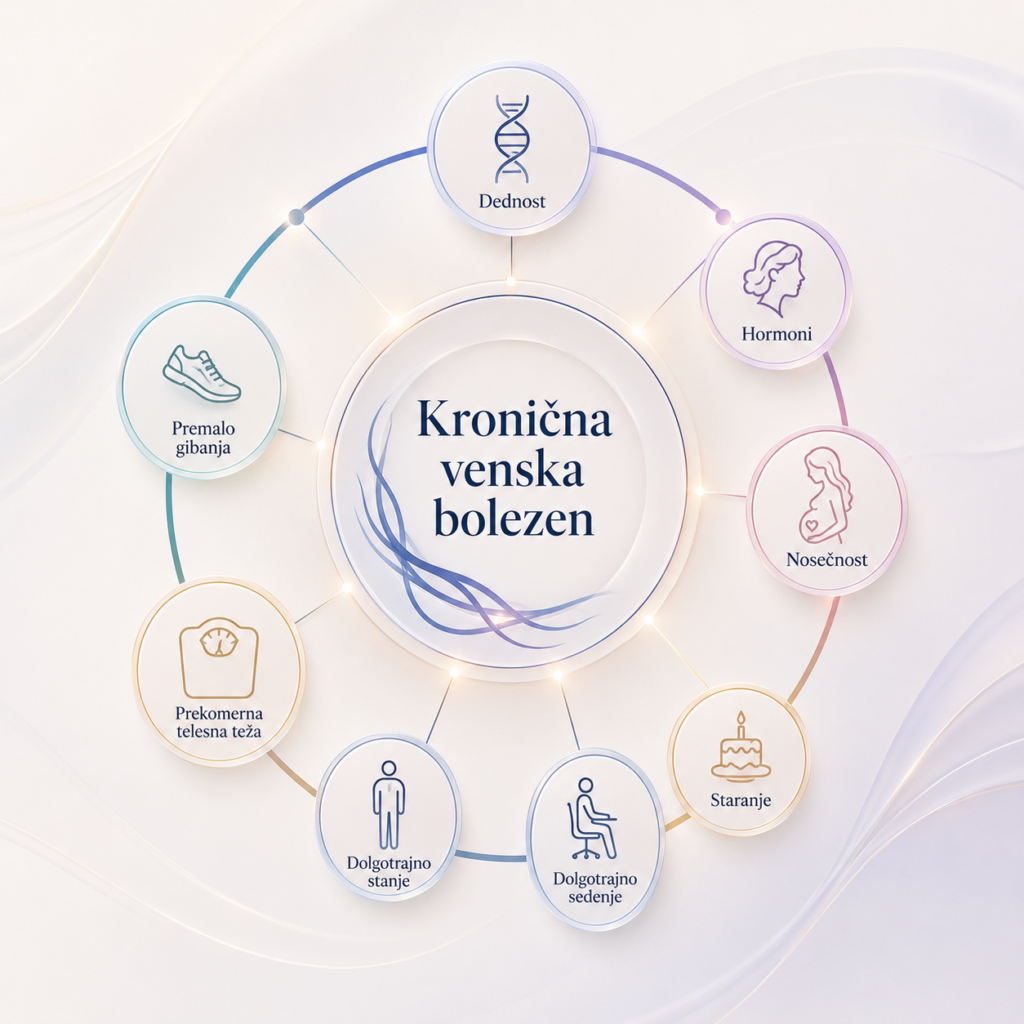
Genetic factors primarily affect the structure of the vein wall, the quality of connective tissue and the function of venous valves. People with a family history are therefore more likely to develop chronic venous disease, which may appear in early adulthood or progress more quickly over time. Although inherited predisposition cannot be altered, knowing about it enables earlier recognition of the disease and timely specialist assessment.
Hormonal factors have an important influence on the development of chronic venous disease, which is why it occurs more frequently in women. Progesterone in particular reduces the tone of the vein wall, allowing veins to dilate more easily and making venous valves less efficient. Hormonal changes can therefore contribute to the onset or more rapid progression of the disease.
During pregnancy, hormonal changes are compounded by an increased circulating blood volume and pressure from the growing uterus on the pelvic veins. This further impedes the return of blood from the legs to the heart and raises venous pressure. The first signs of chronic venous disease often appear during pregnancy, and symptoms commonly worsen during this period in women who already have the condition.
With ageing, the structure and function of the venous system change gradually. Veins lose elasticity, connective tissue becomes less firm, and venous valves become less effective at preventing backward blood flow. As a result, venous pressure and the likelihood of developing chronic venous disease increase. Although the condition can also occur in younger people, its prevalence and progression increase with age.
Excess body weight places additional strain on the venous system and increases pressure in the leg veins. Greater mechanical load and more difficult return of blood to the heart mean that the veins must function under higher pressure, which accelerates their dilation and worsens venous-valve function. Weight reduction can lessen the burden on the venous system and ease symptoms, but it cannot correct damage to venous valves that has already occurred.
Prolonged standing or sitting at work reduces the effectiveness of the leg-muscle pump, which plays a key role in returning blood to the heart. During prolonged standing, the leg muscles do not contract enough; when sitting, blood flow is additionally slowed by flexed hips and knees. As a result, blood drains more slowly from the legs and venous pressure rises, which can contribute over time to the development or progression of chronic venous disease.
People who spend most of the day sitting or standing should take short walks several times a day or perform a few exercises to activate the calf muscles. Even a few minutes of walking stimulates the muscle pump, improves venous blood flow and reduces pooling in the veins.
Post-thrombotic syndrome is a particular form of chronic venous disease that can develop after deep-vein thrombosis. Even after successfully treated thrombosis, venous valves may remain permanently damaged or the deep veins may remain partly blocked, making the return of blood from the legs to the heart persistently more difficult.
Venous pressure therefore remains raised and can cause chronic swelling, pain, heavy legs, skin changes and, in advanced stages, venous ulcers. Because problems can develop or worsen even years after thrombosis, long-term monitoring of the venous system is important for these patients.